
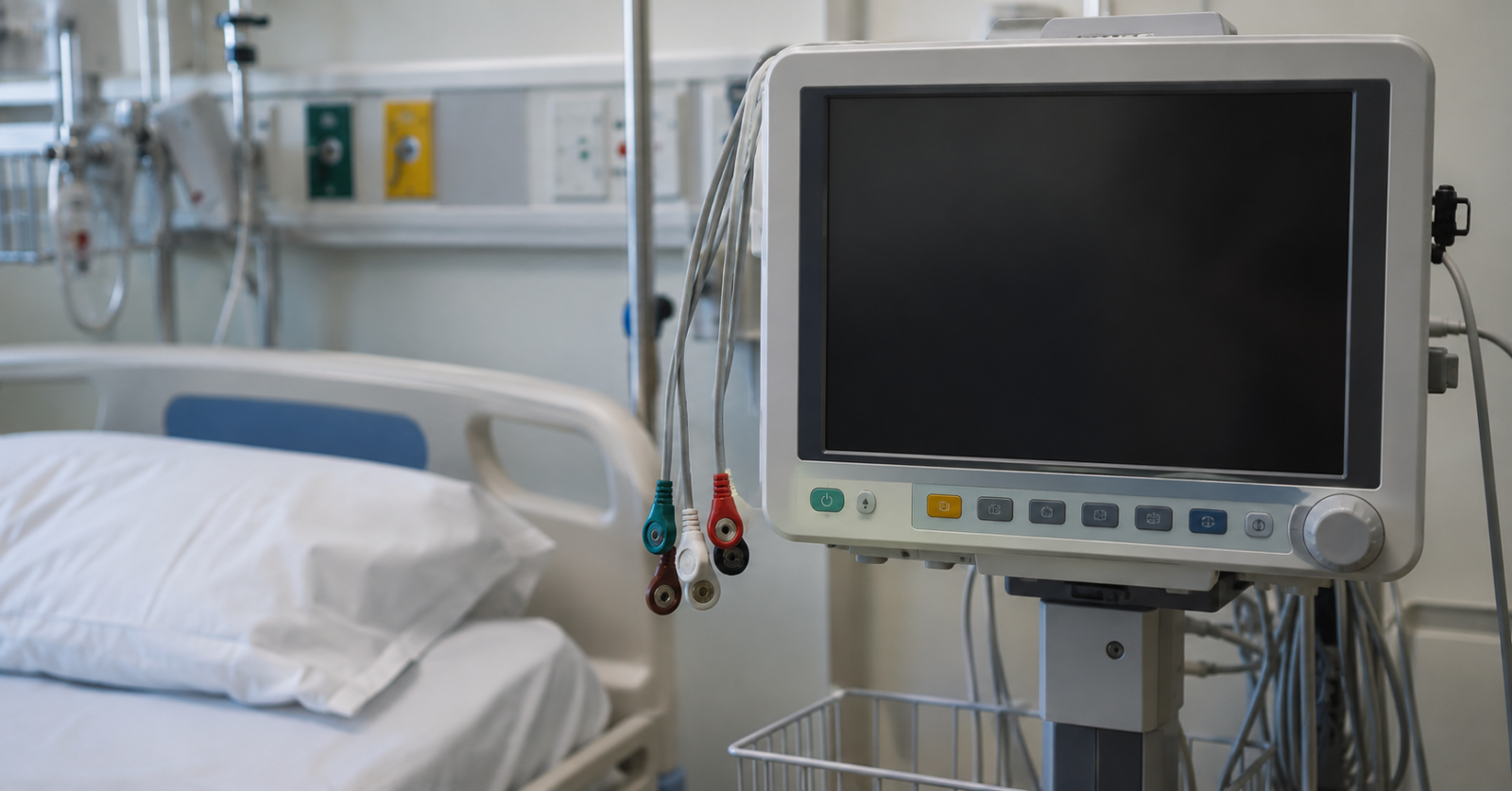
The leads were on his chest from an EKG done hours earlier. The cardiac monitor they were meant to feed had never been connected.
Not long ago, someone we know spent many hours in a busy urban emergency department. At triage in the early afternoon, the staff had what they needed: a brief loss of consciousness and a birth date that placed him in the elderly group. In most emergency departments, that presentation sets off a protocol right away, with hydration and monitoring to rule out a cardiac cause as the imminent danger.
This time, the instruction was to take a seat in the waiting room.
What happened over the next several hours
Two hours passed before a second triage. Blood was drawn and an EKG was done, and then it was back to the waiting room with no word about what would come next. Later a neurologist came to see him and ruled out a seizure. Shortly after, an observation room became available. Over several hours a nurse came in, followed by a medical student and then the resident, all asking the same questions and receiving the same answers.
The attending came last, to recommend admission for continued hydration and cardiac monitoring. When the patient and family asked why, she gave three reasons. A stool sample was needed. More fluids were needed. He needed monitoring. As she spoke, she realized none of it had happened. No stool sample had been taken. He had received a single liter of fluid, and no further bag was running. The monitor had never been connected.
Every test came back within normal limits, and the outcome was favorable. It could have been serious.
The error of assumptions
If you lead a hospital, look at who was in that room. The attending was seasoned. The resident was not new. The providers were professional. The workload appeared manageable, and tests were ordered and performed on time. The gap was in communication, collaboration, and shared responsibility.
That combination is behind a large share of adverse events in healthcare. When the nurse and the physician don’t communicate clearly, each assumes actions that may not have happened. When no one communicates with the patient, the patient and family don’t know what is happening either. They stop trusting the providers, and the providers begin to distrust each other. Psychological safety declines, and physical safety follows shortly after. This is the environment where mistakes occur and outcomes suffer.
National data point the same way. The Joint Commission received 1,575 sentinel event reports in 2024, a 12 percent increase over 2023 [1], and its reviews name failures in communication, teamwork, and inconsistent policy adherence among the leading causes [2].
So the uncomfortable question is simple. How many of your patients had near misses like our friend?
A compass check for your emergency department
If a patient in your emergency department asked right now who is in charge of their care and what happens next, would everyone be able to answer?
A way forward: three changes that would have changed this visit
1. Follow the protocol, and share it with the family. Age plus a sudden brief loss of consciousness triggers the workup for a cardiac cause and monitoring at triage, regardless of how sick a patient looks. Modify as needed based on what the patient tells you and what the tests show. When the patient and family know the protocol, they become partners in the management, and they notice when a step is missed.
2. Huddle at the start, and again when results return. A short initial huddle lets the team agree on the workup, assign individual tasks, and name shared responsibility. When results come back, the team reconvenes quickly to confirm the plan, and the person leading the team confirms each task was done. The evidence is strong. After staff in nine emergency departments were trained in formal teamwork, observed clinical errors fell from 30.9 percent to 4.4 percent [3]. A structured handoff program across nine hospitals cut medical errors by 23 percent and preventable adverse events by 30 percent, without adding time to handoffs [4].
3. Give every name and role, with one person clearly in charge. Everyone caring for the patient introduces themselves, orally and in writing, and one person is named as the lead. This standard is uncommon. In one study of 2,807 hospitalized patients, 75 percent could not name a single physician in charge of their care [5].
From the field
The members of a team should all be responsible to cover each other’s back.
If this case sounds familiar, we would welcome a conversation about what it would take in your emergency department. You can reach us at TalkWithDrKaren.com.
References
- The Joint Commission. Sentinel Event Data: 2024 Annual Review. 2025.
- The Joint Commission. Sentinel Event Data: 2024 Annual Review, contributing factors across event categories. 2025.
- Morey JC, Simon R, Jay GD, et al. Error reduction and performance improvement in the emergency department through formal teamwork training: evaluation results of the MedTeams project. Health Services Research. 2002;37(6):1553-1581.
- Starmer AJ, Spector ND, Srivastava R, et al. Changes in medical errors after implementation of a handoff program. New England Journal of Medicine. 2014;371(19):1803-1812.
- Arora V, Gangireddy S, Mehrotra A, et al. Ability of hospitalized patients to identify their in-hospital physicians. Archives of Internal Medicine. 2009;169(2):199-201.